
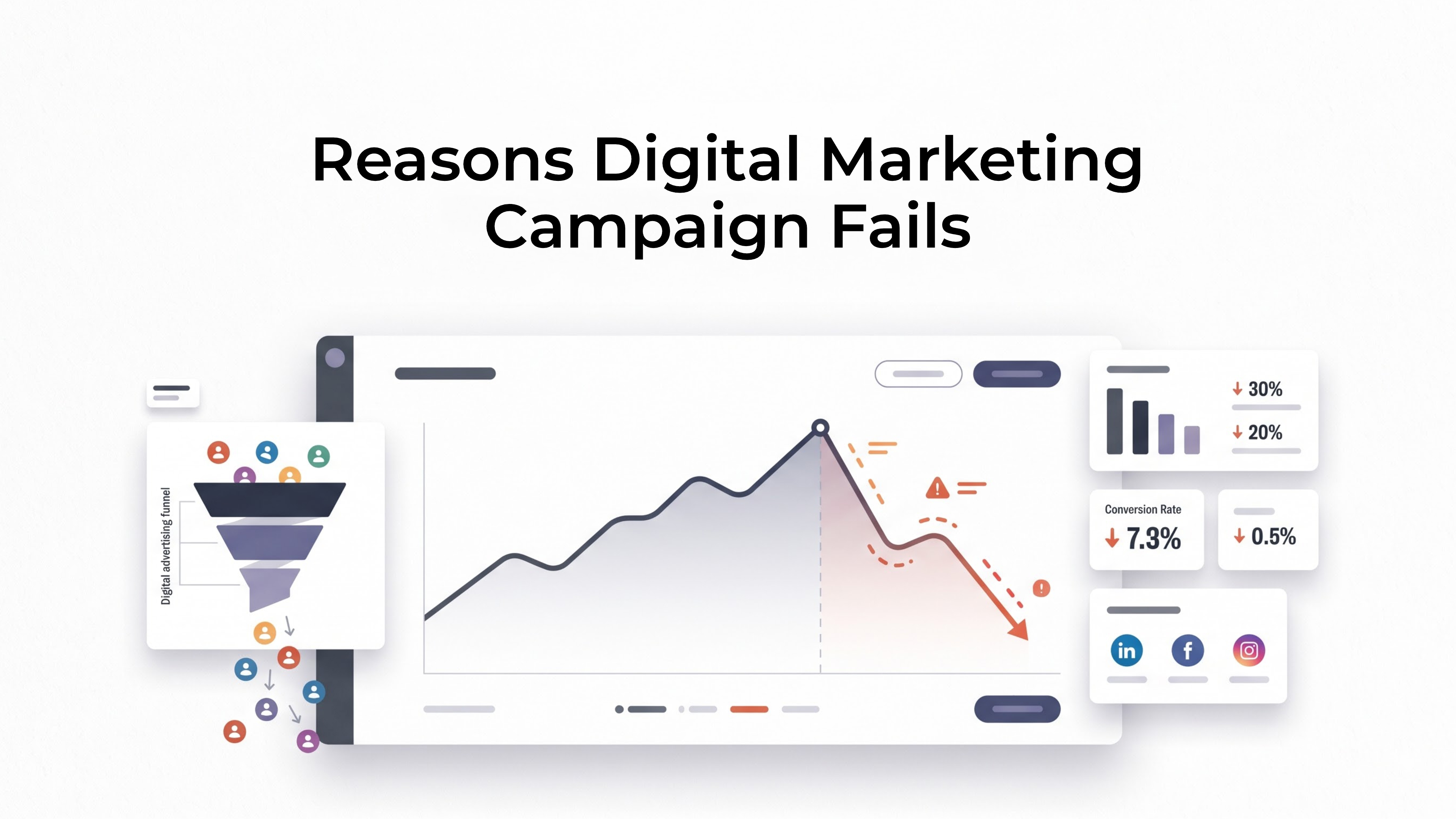
Campaigns can be seen everywhere ranging from the Internet and at other places too but it can still fail to do one thing that it was created for. A business spends lots of money on social media, creatives, even on the Iran paid advertisements to get some likes and clicks. And then they realise that the inquiries or the sales haven't moved much. So the team starts changing captions, posting more often or just increasing the ad budget. But they don't really understand what went wrong in the first place.
A failed marketing campaign is not always the result of bad creative work, but the problem could be an unclear objective, wrong audience or using a message that does not connect. Even when a customer journey is broken and the performance tracking is poor, you’d find your marketing failing.
This article shows you how a failed marketing campaign can be turned into a successful one along with establishing digital marketing campaign strategies that can help to make or break your marketing decisions.
Before we discuss the reasons for a failing marketing campaign, we will first understand how a campaign that has failed is different from the campaign that is underperforming.
A campaign that is designed to increase brand awareness should not just be judged by sales as the only criteria. Similarly, an advertisement which intends to generate enquiries should not be just declared as successful because it received thousands of impressions.
For example, if a business runs a campaign to attract qualified leads, but it receives loads of irrelevant queries, the campaign may be generating activity but it is not meeting its actual goal.
Your marketing campaign performance must be compared with the original objective, the budget, the time frame and the quality of the result. Also, one needs to understand that a new campaign may need some time to collect meaningful data, depending upon its platform and objective and that you may need to review your digital marketing campaign strategy time and again as well.
Businesses sometimes launch campaigns because they want more visibility without deciding what visibility should actually achieve. A campaign may be expected to increase followers, generate website traffic, attract enquiries and increase sales all at once. But when everything is a priority, it becomes difficult to choose the right message, platform and measure success.
Take Apple's 2024 iPad Pro crush advertisement as an example of a failed marketing campaign. Its intended message was to demonstrate the creative capabilities that are packed into their slimmest IPad ever by showing books, musical instruments and much more getting crushed under a press. However this marketing strategy ended up providing a notion of destruction of human creativity for which Apple faced a huge backlash.
The strategic lesson is that having a product message is not enough, but the intended message and the audience's likely interpretation both must align. A clearer campaign strategy would define the audience, their desired response, the core message, and the measures of success before the production of the product even begins.
Businesses often produce products and then advertise them to a large audience and in the hopes of increasing sales dramatically. But a large audience does not automatically mean that it is a relevant audience.
For instance, a business selling premium skin care may attract thousands of views from people interested in beauty trends, but only very few purchases would be received by them because its campaign doesn't reach people who need it or can afford its products. The issue here is the audience selection rather than the product itself.
Another example is another real life example can be taken from Pepsi's advertisement in 2017. It intended to communicate unity and peace through the advertisement featuring Kendall Jenner who is joining a protest and handing a Pepsi to a police officer. Viewers backlashed on this stating that they were treating a social justice protest lightly. Pepsi had to withdraw the advertisement acknowledging it had communicated the wrong message.
This gives us the lesson that a campaign strategy should know different audiences and should involve understanding its experiences, concerns and cultural contexts into the campaign planning, rather than just planning looking at the age group or interest. This data can be easily gathered by using the marketing strategy of taking customer interviews, audience researchers, feedback analysis, and testing campaign concepts with people from the intended audience before launching a fix marketing campaign fully.
While your campaign may look really creative because of all the attractive visuals, celebrity appearances and expensive production cost, it can still fail if you cannot define your unique value and differentiation in one or two sentences. A campaign may be technically polished, and it may still make people question your brand positioning. It especially happens when you rely on the clinches such as high quality at the lowest price without actually providing any proof that aligns with your statement. If a premium product talks about providing something at a low cost price that instantly makes the brand positioning unclear because it makes your customers perceive that your product is compromising on its premiumness.
Creative testing is not limited to checking if the design looks attractive, but it should also examine how you are presenting your brand by examining the tone, the language, emotional and relevance of the campaign.
If your campaign attracts the right people, but the next steps make it difficult for them to act, then too your campaign fails. Imagine that a customer is clicking an advertisement for a website design packaged advertised at a particular starting price. Now the landing page shows a journal company introduction, does not explain what the package includes, and ultimately makes a visitor fill out a very lengthy form before seeing useful details. This makes a consumer must simply leave.
Google Ads official guidance recommends making ads relevant to the targeted keywords and to ensure that the landing page looks relevant, loads quickly, and even has a clear call to action. It also identifies conversion, tracking market campaign performance and targeting issues among the areas advertisers should troubleshoot.
A campaign strategy to fix this is to check the complete path from advertisement to the landing page then to the inquiry or purchase. As a part of this marketing strategy, businesses need to make sure that the offer, pricing information, message and the next step are consistent, not confusing and load quickly. It should also test the firm's mobile usability, loading speed and conversion tracking before increasing the budget and launching the ad.
A campaign marketing performance report may show impressions, clicks, cost per click and engagement, but if the business is not aware which click turns into qualified enquiries or sales, it can not definitely decide what to improve.
Google's guidance identifies the several reasons campaigns.May have that leads to low traffic or declining performance. This includes limited budgets, narrow targeting, creative limitation, conversion, tracking issues, and certain other dynamics.It also suggests that the businesses should wait upon the marketing strategies so as to learn where they are going wrong rather than keeping on changing them constantly just because the numbers are not met.
Here are certain practical marketing strategies for same:
Fixing a failed marketing campaign starts with diagnosis, not just with investing more money, more content, or going onto newer platforms.
SMART goals
Fix Core Messaging
Audience Mapping
Launch Planning
A failed marketing campaign is not a failure it just reveals where the digital marketing campaign strategy needs work. A campaign may struggle due to various reasons but spending more money makes no sense.
Ask better questions, listen to your audience and fix marketing campaigns by using strong marketing. A strong campaign strategy will never promise that you are each and every campaign will succeed, but it will give the business a learning lesson and a better understanding of which decisions to make and which to not. Connect with us and learn better about campaign decisions.
