
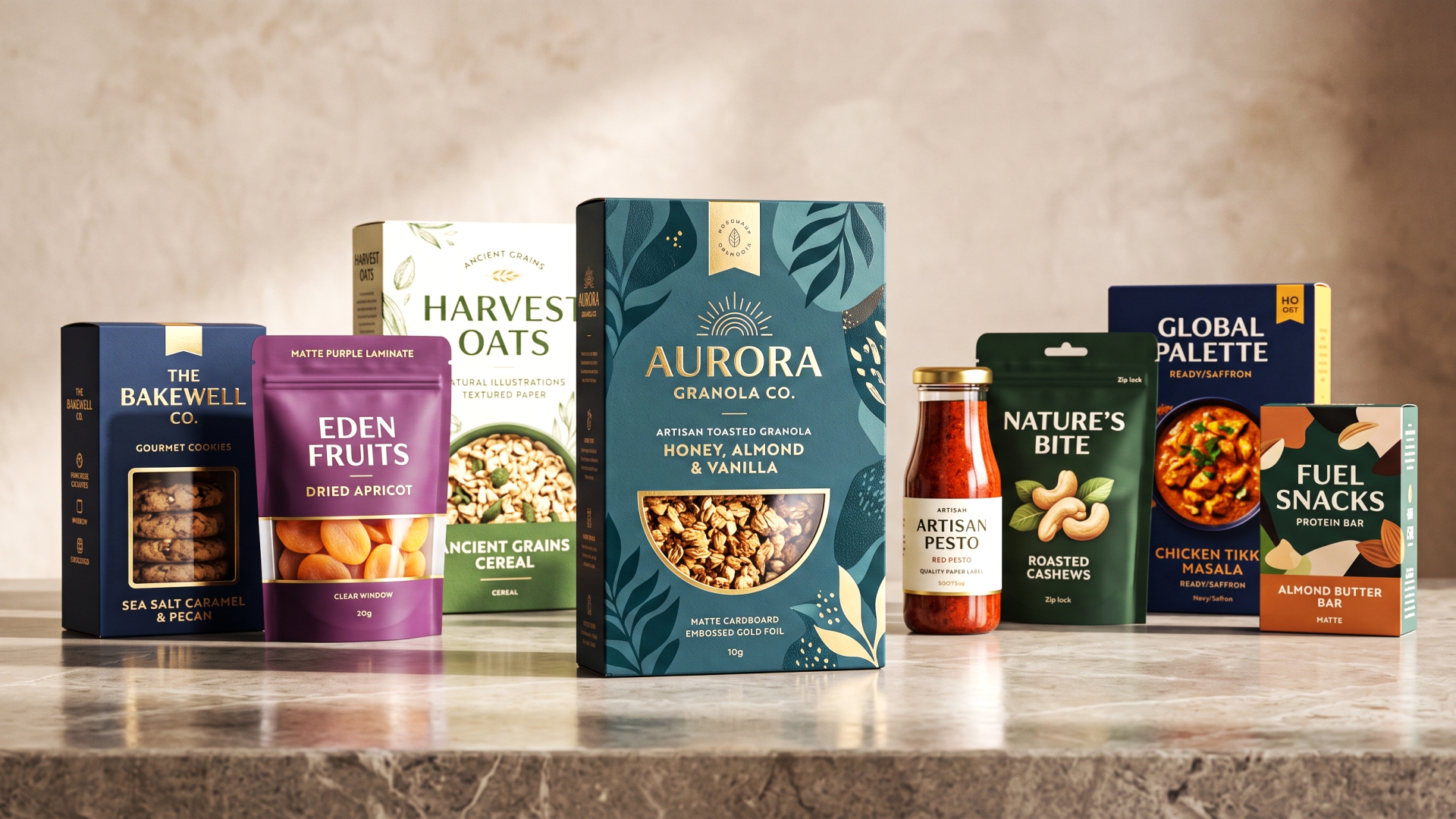
You taste food with your eyes first. Before a spoon hits the dessert or crunchy packet, boxes, the wrappers, or the jar; it tells a story that lits your appetite up.
Ever thought what makes you pick up that one bar of chocolate off a crowded shelf and leave the rest behind? Obviously it won't be just the cocoa because it is the same everywhere, but it is the magic of a brilliant food packaging design. You don't read every label and neither do you compare every ingredient list while standing near the shelves. Often the food packaging design creates the first impression. The food packaging isn't just a protective layer around the product, but it is your silent salesperson; a strong packaging branding speaking for itself.
The product packaging design made by a packaging design agency grabs the attention of the consumers long before they even pick the product off the shelf. The food packaging design develops an understanding of the product because it communicates the quality and the positioning of the product, thus leading to the users trusting it. It also helps the product to stand out and differentiate with a similar product. This builds the preference of the consumers and influences customers to even purchase it.
Food packaging design actually performs 3 main important jobs.
1. It gets attention
The colour, the typography, imagery, shape and the colour hierarchy determine whether the product packaging design would be noticed or not.
2. It communicates information
Without even tasting the product, the customer should understand what the product is. Whitening seconds, customers should understand what the product is, who it is for and what makes it different from the other products on the shelf.
3. It creates experience and expectations
A premium food packaging design can indicate premium positioning of the product, minimal packaging communicates simplicity, and bright, playful packaging can appeal to younger audiences. Basically, packaging communicates before customers even look into further details.
A common mistake that packaging design agencies make is they think ‘What do we want our product to look like?’
Instead they need to ask ‘What does our customer need to see, understand and feel about the product?’
Finding the target audience, their age, lifestyle choices, occasions on which they buy, how price sensitive they are, their preferences and competitor expectations can help to make the product packaging design well.
For instance, for a premium organic snack, designing shouldn’t have the same visual language as a children's cereal packaging. Both of them are food products, however their customers positioning and purchase triggers are completely different.
Your food packaging design should speak for itself and recognition matters. Thus, customers should be able to identify your brand quickly amongst the competitors when they pick your product from the shelf.
In order to let the packaging branding happen, packaging needs to create consistency across all the elements they use. Elements such as logo, the colour palette, typography, imagery, illustration styles, icons and layout should remain consistent.
This would make you question what about brands that offer multiple products? Let’s take an example of a brand that makes chips, namkeens, biscuits and snacks. All of these are different products, and even when they look different; maintaining consistency across these certain elements will help to make the brand recognisable. This is called packaging branding, where consistency doesn't mean making every packaging identical, but it means making the brand recognisable.
Colors used in food packaging design can influence the attention of the customers. It makes product recognition easier. It also helps you to perceive the flavour of the product and set some category expectations. Colours can also generate emotional response from the customers and provide a premium perception to the product.
Let's take an example of the rigid claim that states red means appetite. Actually, colour meanings depend on the category of the product, the culture where the brand is trying to introduce the product and where it is stemming from, context of the product, the competitor environment and the positioning of the brand. A colour palette should work both ways, individually and on the shelf alongside the competitors. Thus choosing the right product packaging design colours caters to the colour psychology as well.
Customers have to hunt for basic information when they pick your product, consider your product packaging design fails.
A strong packaging branding hierarchy determines what the customers notice first, second and the third. The very first thing that the customer should notice is the brand of your product. Secondly, they should notice which product it is and why it creates a difference. Third thing should be the key information regarding your food packaging. This could include anything ranging from the flavour, quantity, and benefits to variance. Lastly, the supporting information regarding ingredients, nutritional information and certification should come in the hierarchy.
More information isn't necessarily making the packaging more informative. A good food packaging design prioritises information but at the same time keeps intentional white space so that the packaging doesn't look too cluttered.
Role of Product Photography and Imagery
Food is a highly visual experience. Images on the food packaging design can influence appetite, perceived freshness, quality, flavour, expectations and usage occasion of the customers.
A good packaging design agency would know to avoid generic stock photography that looks unrealistic, does not match the actual product and makes the brand looks interchangeable. The better visual approach should communicate what the product is, how it feels and why should customers want it. This is why custom food packaging offered by packaging designing agencies play an important role in making the product more appealing.
Readability and Creativity Go Hand-in-Hand
A packaging design agency knows that while designing a custom food packaging the creativity goes hand-in-hand with readability.
If your customers need to understand what you are selling, it means that the design is doing too much. Using tiny fonts, low contrast, excessive decorative elements, confusing layouts and overcrowded front panels will make the food packaging design non-functional and unappealing. A creative custom food packaging needs to remain functional and customers should quickly be able to locate relevant information in your packaging.
Categories can become visually repetitive. Think about the shares which are filled with snack packets, sauces, biscuits, beverages and ready to eat products. Thus, food packaging design needs to introduce differentiation through use of colours, structure, illustration, typography and other factors. Even the format, material, storytelling and the photography play an important role in the differentiation of the product. But remember, being different is not enough. A good packaging design agency knows that the packaging must still communicate the category and the product clearly. They know that making the product distinctive, relevant and recognisable is the key to packaging branding.
Product Packaging Design for Physical and Digital Shelves
Customers are not just discovering products through the supermarket shelves, but even through Instagram websites, quick commerce apps, e-commerce platforms and digital advertisements. Food packaging design needs to work at the recognizability of the design at any avenue and here comes the role of custom food packaging.
This may include making custom food packaging at avenues such as the e-commerce thumbnails where the customers are seeing the product from a few centimetres wide, or social media where the photograph is displayed, or on the website where the packaging is communicated clearly in the product photography.
Customers who choose food packaging design are also paying attention to the material of the packaging, its recyclability, packaging quality and how reusable it is. Sustainability should be designed into custom food packaging not just printed onto it. Many packaging design agencies partake in greenwashing that is they make vague claims on the packaging declaring it as eco friendly, green, and sustainable without any evidence. A good packaging design agency makes the packaging sustainable, not just declares it randomly.
Food packaging design agencies contribute beyond aesthetics. A strategic packaging design agency will do market research first to understand the whole category and its competitor. It would then define what the product should stand for and choose the visual language that would appeal to the customers. This is another strategy a good packaging design agency follows; it creates consistency across SKUs and sees if the design works in real world printing or not. It tests whether the design communicates itself quickly or not and thus the food packaging design is made strategic.
These are certain pointers of food packaging design should be able to make easily scannable:
A great packaging designing agency knows that a packaging doesn’t only have to be beautiful; it needs to attract, communicate, differentiate, build trust and convert the customers. The strongest of the food packaging designs should combine brand strategy, consumer psychology, visual communication, functionality and production realities. Your packaging is the first salesperson your customers meet. Make sure that you give them a reason to pick your product up and take it home.
